

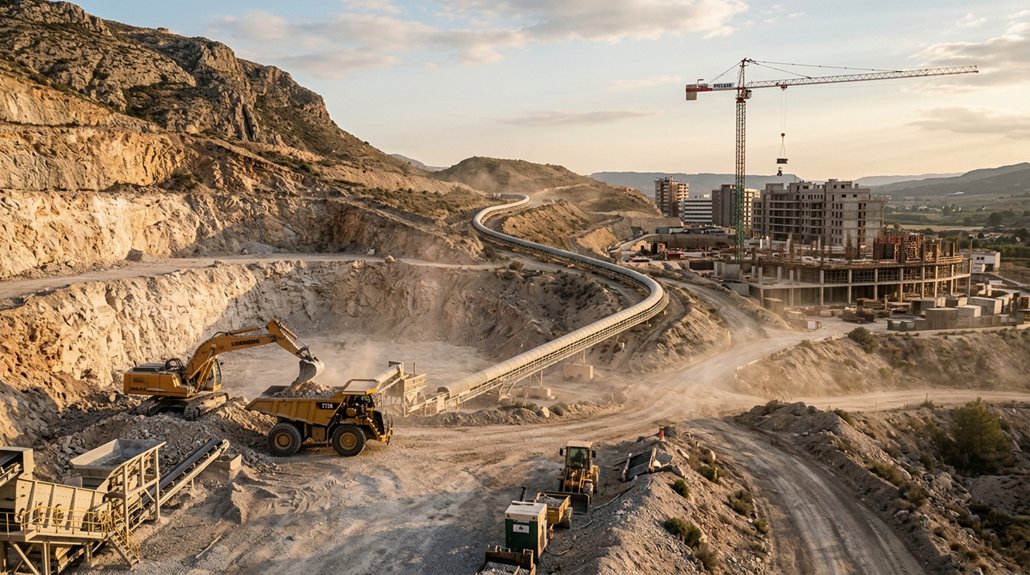
Is it true that the aggregate beneath your project can be traced from bedrock to the building site through a predictable supply chain? You’ll see how geology and recycled materials shape sourcing, while extraction, crushing, screening, and grading prepare aggregate for use. Trucks, rail, and barges move it toward your site, but maintenance, weather, traffic, and access can disrupt delivery. The key is understanding where delays begin—and how coordination keeps material moving.
Where Does Construction Aggregate Come From?
Where does construction aggregate come from? You’ll find it in naturally occurring deposits of sand, gravel, and crushed stone, as well as in recycled construction materials.
Geologic history determines the composition, grading, and durability of each deposit, while regional availability influences supply routes and delivered cost. Producers and buyers assess material specifications against project requirements, including strength, particle size, and consistency.
Your sourcing decisions also shape environmental impact. Transport distance, land use, water demand, and habitat effects vary by source, so you’ll need to weigh these factors alongside performance and cost.
Recycling processes can recover aggregate from demolished concrete and asphalt, returning suitable material to construction markets and reducing demand for virgin resources. Recycled supply depends on feedstock quality, contamination controls, and project specifications.
Understanding these source options helps you plan procurement before material enters production and distribution.
How Is Aggregate Extracted and Crushed?
Aggregate extraction and crushing convert a deposit into material that meets defined size and quality specifications. You’ll see mining techniques selected to suit geology, deposit depth, and site conditions.
At a quarry, crews remove overburden, then use drilling and controlled blasting to loosen competent rock. Excavators and loaders move the material to a primary crusher, where compression breaks large fragments. Secondary crushers reduce them further to the required feed size.
- Each blast is planned to limit vibration and protect nearby communities.
- Your haul routes are designed to reduce dust, fuel use, and delays.
- Crusher settings are monitored to control particle size and equipment wear.
- Environmental impact is managed through water sprays, noise controls, and progressive site rehabilitation.
These steps turn in-situ rock into transportable aggregate while maintaining worker safety and consistent production.
How Is Aggregate Screened and Graded?
After crushing, material passes over vibrating screens that separate it into specified size fractions. Screen decks use apertures selected for the product specification; finer meshes retain smaller particles, while larger openings allow coarse aggregate through.
You’ll see operators adjust feed rate, vibration amplitude, and screen angle to maintain throughput and limit blinding. Oversize material may return for further crushing, while undersize fractions are collected separately.
Grading controls particle-size distribution, which affects compaction, drainage, and concrete or asphalt performance. Quality testing verifies sieve analysis, fines content, and compliance with applicable standards.
You’ll also monitor moisture and contamination, since both can distort results and product consistency. Efficient screening reduces rehandling and supports resource use; dust suppression and noise controls help limit Environmental impact around the plant.
Each fraction is documented against its intended specification before release.
How Does Aggregate Reach the Building Site?
Once graded and approved, aggregate moves from the plant to the building site by truck, rail, or barge, depending on distance, volume, and access. Your delivery method shapes cost, handling, and site readiness.
- Truck: Flexible routing brings loads directly to the project, where you’ll need suitable access and unloading space.
- Rail: High-capacity shipments serve projects near sidings; transfer equipment moves material to trucks or stockpiles.
- Barge: Water transport carries bulk aggregate efficiently when navigable routes and receiving facilities are available.
- Coordination: Transportation logistics align carrier capacity, load records, delivery windows, and receiving plans, so your crew can place material efficiently.
Each mode affects fuel use, emissions, and handling losses. Comparing these factors helps you assess Environmental impact while meeting project specifications.
At delivery, you verify the product, quantity, and documentation against the order before directing it to the designated stockpile or placement area.
What Can Delay an Aggregate Delivery?
What can delay an aggregate delivery? Your shipment can arrive late when quarry production, loading capacity, or dispatch schedules fall behind.
Equipment maintenance is a key factor: unplanned crusher, loader, or conveyor downtime can reduce output and leave trucks waiting.
Weather may restrict extraction, stockpile access, or road conditions, while wet material can require extra handling.
Transportation logistics also shape delivery timing. Traffic congestion, route restrictions, bridge limits, and driver-hour regulations can extend transit or force rerouting.
At the site, a blocked entrance, inadequate unloading space, or unavailable receiving crew can prevent a truck from tipping on schedule.
You can reduce exposure by confirming load specifications, access conditions, delivery windows, and backup routes with your supplier.
Clear communication helps you adjust sequencing before delays disrupt placement, equipment utilization, or downstream construction activities.
Frequently Asked Questions
Which Aggregate Types Are Best for Concrete, Asphalt, and Drainage?
For dependable performance, you’ll want the right stone in the right place: concrete typically uses clean, well-graded sand and gravel or crushed stone.
Asphalt favors angular, durable crushed aggregate that interlocks.
Drainage calls for clean, open-graded gravel or crushed rock that lets water pass.
Check Aggregate durability against loading, weather, and exposure, and use Source selection processes that verify grading, cleanliness, and compliance with project specifications before delivery.
How Do Recycled Aggregates Compare With Virgin Materials?
Recycled aggregates can match virgin materials in many applications, but you’ll need to assess source quality, processing, and specification limits.
Recycled content reduces demand for quarried resources and can lower disposal impacts; however, variability in particle shape, grading, contaminants, and absorption may affect mix design and performance.
Check testing data and project requirements before substitution.
Material durability depends on feedstock and processing, so you shouldn’t assume recycled products are suitable for every structural or exposure condition.
What Environmental Impacts Can Aggregate Production Have?
Aggregate production can disturb habitats, consume energy and water, generate dust and noise, and increase greenhouse-gas emissions. As a bird lifts off just when a crusher starts, you can picture how extraction and processing alter nearby ecosystems.
Habitat disruption may fragment wildlife corridors and affect soil and waterways. You’ll find that Environmental regulations govern permits, emissions, runoff, and rehabilitation, but impacts still depend on site conditions, extraction methods, transport distances, and mitigation practices.
Which Quality Standards Apply to Construction Aggregates?
Construction aggregates must meet standards appropriate to their intended use, including particle size, grading, strength, durability, and contaminant limits.
In the U.S., ASTM specifications commonly govern aggregate for concrete, asphalt, and base courses. European projects often use harmonized EN standards, such as EN 12620 for concrete aggregates.
You should verify project specifications, local regulations, and test results.
Quality certification and supply chain management help you document compliance, maintain traceability, and guarantee consistent deliveries.
How Should Aggregates Be Stored to Prevent Contamination?
Keep each aggregate size and source in a separate, clearly labeled stockpile on a clean, hard, well-drained surface.
How can you protect a pile from muddy runoff and stray debris? Shape the pad to shed water, install drainage controls, and use barriers where needed.
For effective Contamination prevention, keep loaders and haul routes clean, avoid mixing materials, and cover or shelter stockpiles when practical.
Follow Storage best practices by inspecting piles regularly and removing contaminated material before use.
Leave a Reply