

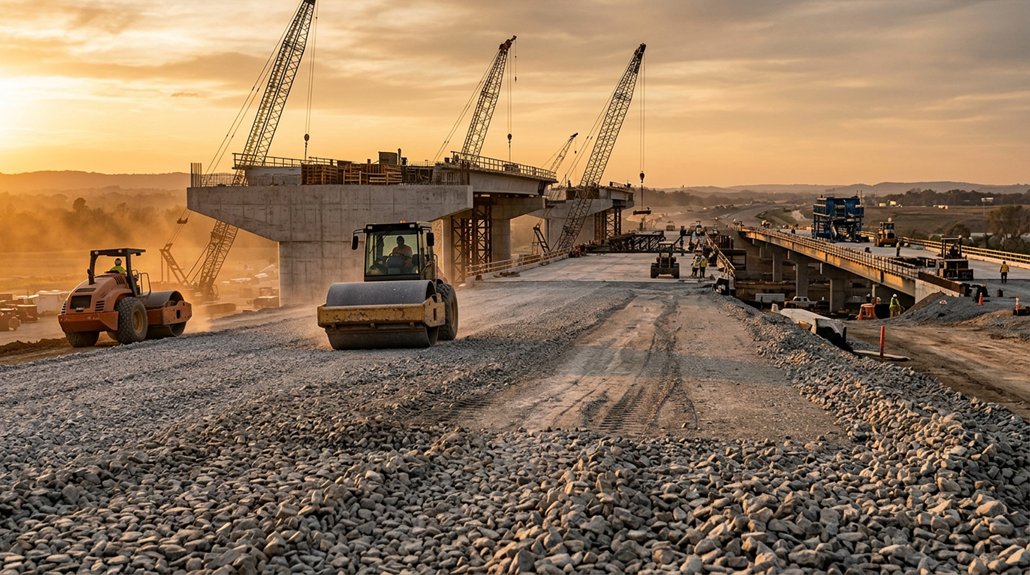
You need roads that carry heavy loads, railways that hold alignment, and drainage systems that control water. Crushed stone supports each by forming a compact, interlocking base that limits movement and helps distribute pressure. Its performance depends on more than simply placing aggregate: you’ll need to match stone size and type to the site, the load, and the drainage requirements. Choose poorly, and even a well-built project can settle or fail.
Why Infrastructure Projects Use Crushed Stone
Infrastructure projects use crushed stone because its angular particles interlock under compaction, creating a stable base that distributes loads and resists movement. You’ll also find it specified for roads, railways, drainage systems, and utility corridors because it’s durable, widely available, and adaptable to demanding site conditions.
Different gradations let you match aggregate to design requirements, while consistent quality supports predictable construction and maintenance. Consider environmental impact when selecting sources: local quarries can reduce transport emissions, but extraction may affect habitats, water, and nearby communities.
Cost considerations include purchase price, hauling distance, placement, and long-term upkeep; the lowest material quote may not deliver the best project value. Verify gradation, cleanliness, and applicable specifications before ordering, and coordinate delivery with site access and construction schedules to prevent delays and unnecessary handling costs. Companies such as Agg-Pro who you can find at https://agg-pro.com/crushing-solutions/ provide high quality product and structured delivery processes to ensure that your project meets its deadline.
How Crushed Stone Creates Stable Foundations
When properly graded and compacted, crushed stone forms a stable foundation by locking angular particles together and distributing loads across the subgrade. You’ll get reliable support when the aggregate’s size and layer depth match site conditions and design requirements.
Angular faces interlock under compaction, limiting particle movement and helping maintain soil stability. The stone layer also improves load distribution, reducing concentrated pressure on weaker ground below.
Before placement, you should assess drainage, subgrade strength, and the risk of settlement. Remove unsuitable material, correct soft spots, and compact the prepared surface to specification.
Place stone in controlled lifts, then compact each lift uniformly; excessive thickness can leave loose zones that compromise performance. Verify density and finished elevations through inspection and testing.
With sound preparation and quality control, your foundation can resist deformation and support the structure above.
Crushed Stone for Roads, Railways, and Airports
Across roads, railways, and airports, crushed stone provides load-bearing layers that support heavy traffic and help control water. For highways, you’ll find graded aggregate beneath pavement that distributes wheel loads and limits deformation.
Rail lines rely on compacted ballast to hold sleepers in position, resist lateral movement, and maintain track geometry under repeated train loads. Airport pavements need carefully specified stone bases to withstand aircraft weight, braking forces, and frequent operations.
Match stone size, strength, and gradation to design requirements; inconsistent material can compromise performance and increase maintenance. During placement, follow Construction safety procedures for haul trucks, graders, and compaction equipment, and verify density and layer thickness.
You should also assess environmental impact by sourcing responsibly, reducing waste, and controlling dust. These measures support reliable transport infrastructure throughout its service life.
How Crushed Stone Improves Drainage and Concrete
Because crushed stone has interlocking particles and controllable void spaces, it can both drain water and strengthen concrete. In drainage layers beneath roads, foundations, and retaining structures, these spaces let water move away from vulnerable areas instead of building pressure. You’ll improve Drainage efficiency by maintaining clear flow paths and providing suitable outlets, helping limit saturation, erosion, and freeze-thaw damage.
In concrete, crushed stone serves as coarse aggregate, forming a stable skeleton within the cement paste. Its angular particles can bond effectively with the surrounding matrix, supporting load transfer and reducing excessive shrinkage when the mix is properly proportioned.
This Concrete reinforcement helps you build slabs, bridges, and structural elements that resist service stresses. Clean, well-graded aggregate and consistent mixing matter: contamination or poor consolidation can weaken the finished concrete and undermine long-term performance.
How to Choose Stone Size and Type
Choosing the right crushed stone size and type depends on how the material will perform in the project. Start by matching aggregate size to the design requirements. You’ll need coarse, angular stone for stable road bases, while smaller, graded aggregate suits concrete mixes and compacted surfaces. Check project specifications for particle-size distribution, strength, and drainage criteria before ordering.
Next, assess the stone’s geological properties. Hard, durable rock resists abrasion and weathering; softer material may break down under heavy loads or freeze-thaw cycles. Confirm that the source meets applicable testing standards and is free of contaminants that could weaken the structure.
Consider environmental impact, too. Choose a nearby, responsibly managed quarry where practical to reduce transport emissions. Verify availability, consistency, and delivery capacity so your selected aggregate supports construction schedules without compromising performance or budget.
Frequently Asked Questions
Is Crushed Stone Environmentally Sustainable?
Crushed stone can be environmentally sustainable when you manage extraction, transport, and reuse responsibly. Its environmental impact includes habitat disruption, dust, noise, and emissions from quarrying and hauling.
You can reduce these effects by sourcing locally, requiring site restoration, and choosing suppliers with strong environmental controls.
Recycling practices also help: reclaimed concrete and asphalt can replace some virgin aggregate.
Sustainability depends on project needs, sourcing, and lifecycle performance, not on the material alone.
How Is Crushed Stone Produced?
Crushed stone is produced by extracting solid rock from a quarry, then crushing and screening it into specified sizes. You’ll typically see the process begin with drilling and blasting, followed by hauling rock to primary crushers.
Secondary crushers reduce it further, while screens separate particles by size. Material grading guarantees each product meets project specifications.
Production machinery may include jaw, cone, and impact crushers, conveyors, and vibrating screens; washing can remove excess fines when required.
Can Crushed Stone Be Recycled After a Project?
Yes—you can recycle crushed stone after a project, giving it an astonishing second life instead of sending it straight to a landfill. Recycling processes typically involve collecting, sorting, crushing, and screening the material to remove contaminants and achieve suitable sizes.
You can then use the recycled crushed stone for road base, drainage layers, construction fill, or other applications. This material reuse reduces demand for newly quarried aggregate, cuts disposal needs, and supports efficient project planning.
What Safety Precautions Apply When Handling Crushed Stone?
When handling crushed stone, protect yourself from impact, sharp edges, and airborne dust. Wear appropriate Personal protective equipment, including safety glasses, sturdy gloves, steel-toed boots, and a properly fitted respirator when required.
Use dust control measures such as wetting material or operating local exhaust ventilation; avoid dry sweeping.
Keep hands clear of moving equipment, use safe lifting techniques, and maintain stable footing.
Follow site procedures, inspect tools, and report hazards promptly.
Never handle loads beyond your capacity.
How Should Crushed Stone Be Stored On-Site?
Store crushed stone on a firm, well-drained surface, separated by size and type to prevent mixing and contamination. Use designated, clearly marked stockpiles, keeping them away from traffic routes, drains, and unstable slopes.
Your Storage methods should limit segregation: build piles in controlled lifts and avoid dropping material from excessive heights.
For On site handling, use clean equipment, maintain safe access, and cover or dampen piles when dust or runoff could become a concern.
Leave a Reply