

You could search half the world and still not find a roofing material shaped by time as precisely as slate. When you specify it for a roof or façade, you need to know how quarrying, splitting, grading, and testing affect its performance. The process begins with metamorphic rock and ends with carefully supplied sheets—but one detail in the stone determines whether it will last for generations.
Where Does Roofing Slate Form?
Roofing slate forms when fine-grained sedimentary rock, such as shale or mudstone, is buried and subjected to low-grade heat and pressure during regional metamorphism. This Geological formation aligns clay minerals and compresses the rock into thin, durable layers with natural cleavage.
For roofing, you’ll find suitable slate in regions where these conditions occurred and the resulting stone remains dense, relatively unweathered, and consistent in thickness.
Slate color depends chiefly on the original mineral content and the conditions of metamorphism. Iron-bearing minerals can produce green, purple, or red tones; carbon-rich material commonly yields gray or black.
You may also see subtle variation within a deposit, so assess color consistency alongside strength and weather resistance when specifying a roof. Regional geology determines the slate’s texture, appearance, and performance, giving you practical criteria for comparing sources.
How Is Roofing Slate Extracted?
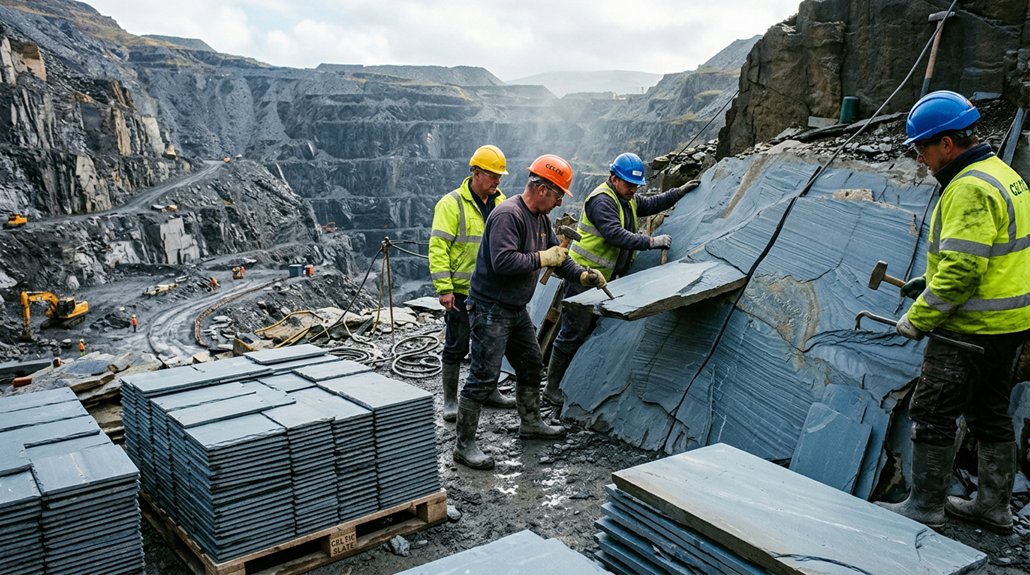
Once a slate deposit is exposed, quarry workers remove overburden and extract the stone in blocks, using controlled blasting, drilling, or mechanical cutting suited to the site’s geology. You’ll find the method depends on rock strength, joint patterns, access, and production requirements.
Slate quarrying machinery may include diamond-wire saws, drills, excavators, and lifting equipment; operators select tools to limit vibration and protect usable material. Where blasting is necessary, carefully planned charges help control fragmentation and reduce risk to workers and nearby structures.
Extraction proceeds in benches, with stable faces and designated haul routes supporting safe movement of blocks. Water management and dust suppression are also essential.
To assess Environmental impact, you should consider noise, energy use, runoff, and habitat disturbance; responsible quarry plans include monitoring, mitigation, and progressive site restoration.
How Is Roofing Slate Split and Graded?
After extraction, slate blocks are split along their natural cleavage planes, which let workers separate the stone into thin sheets without sawing through its grain. Skilled splitters use hand tools to open each block, controlling force to produce sheets of the required thickness.
They then trim the pieces to specified dimensions and inspect them for cracks, uneven surfaces, mineral inclusions, and other defects. Grading assesses thickness, flatness, edge quality, and visual consistency, so you can select material suited to your project’s specification.
Slate color is checked across batches because natural variation can affect the finished appearance. Quality control also considers slate durability, using established standards and tests to identify stone that may fail during handling or installation.
Rejected pieces are removed; accepted slates are sorted, counted, and packed for supply.
Why Does Roofing Slate Suit Roofs and Buildings?
Because slate has low water absorption and strong resistance to weathering, it can protect a roof through decades of exposure when properly installed. Its weather resistance helps limit damage from rain, frost, and temperature changes, while its dense structure supports long service life with modest maintenance.
You’ll need to match slate thickness, size, and fixing method to the roof’s pitch and structural capacity; correct detailing around ridges, valleys, and penetrations is equally important.
Slate’s natural variation in colour, texture, and cleavage gives your building distinctive aesthetic appeal, from consistent courses to more varied patterns.
It’s also non-combustible and dimensionally stable, making it suitable for many architectural applications beyond roofing, including cladding and flooring.
Choose it when durability, visual character, and long-term performance justify the installation requirements and initial cost.
How Is Roofing Slate Tested and Supplied?
How can you tell whether roofing slate will perform as specified? Check its test results, grading, and documentation before purchase. Suppliers assess slate for water absorption, freeze-thaw resistance, flexural strength, and resistance to thermal cycling, using recognised standards where applicable. These tests help verify slate durability and suitability for your climate, roof pitch, and design requirements.
You should also confirm the product’s origin, thickness range, dimensions, and permitted tolerances. Ask for declarations of performance, test reports, and clear guidance on fixing and sorting.
Before delivery, agree quantities, packaging, access, and breakage procedures with your supplier. Inspect each batch on arrival, separating damaged or inconsistent pieces. Your roofer can then select compatible slates and fixings for roofing installation, following manufacturer guidance and local building requirements.
Keep records to support traceability and future maintenance.
Frequently Asked Questions
How Long Does a Slate Roof Typically Last?
A slate roof typically lasts 75 to 150 years, though premium slate can endure longer. Your roof’s actual service life depends on slate quality, installation, climate, ventilation, and structural support.
These Durability factors matter: poor flashing or inadequate fixings can cause failures well before the slate wears out.
For Lifespan extension, have you inspect the roof periodically, replace damaged slates promptly, and maintain flashings and drainage.
Choose experienced contractors for repairs and avoid unnecessary foot traffic.
How Much Does a Slate Roof Cost?
A slate roof is a long-term investment, like buying a sturdy bridge instead of a temporary crossing. You’ll typically pay $10–$30 per square foot installed, or $20,000–$60,000 for a 2,000-square-foot roof; premium slate and complex designs can cost more.
Cost comparison should include underlayment, structural reinforcement, labor, and disposal.
Material durability helps explain the higher upfront price: slate can last 75–150 years, reducing replacement frequency.
Get local, itemized quotes before deciding.
Can Slate Roofing Be Installed on Any Roof?
No, you can’t install slate roofing on every roof. Your structure must support its substantial weight, often requiring an engineer to assess rafters and decking.
Roof pitch, shape, and condition also matter; slate generally needs a sufficiently steep slope and sound underlayment.
Historical uses demonstrate its durability, but suitability depends on your building.
Consider Environmental impact too: slate can last for generations, though quarrying and transport carry impacts.
Consult a qualified slate-roofing contractor before deciding.
How Should a Slate Roof Be Maintained?
A slate roof lasts longest when you inspect it regularly and repair problems promptly—small checks prevent costly leaks. Schedule a professional inspection annually and after severe storms.
Keep gutters and valleys clear, remove debris gently, and trim overhanging branches. Don’t walk on the slates; you can crack or dislodge them.
Have a qualified roofer replace damaged tiles and check flashings, fixings, and underlayment. Proper Slate installation and routine Maintenance techniques protect your roof’s durability.
Can Damaged Slate Tiles Be Repaired or Replaced?
Yes, you can repair or replace damaged slate tiles, depending on the damage. For a small crack, a qualified roofer may use a compatible repair method.
But loose, broken, or badly delaminated slates usually need tile replacement. During slate restoration, your roofer should check nearby tiles, flashing, and fixings to identify related problems.
Don’t walk on the roof; slate can break underfoot.
Prompt repairs help prevent water entry and damage to the roof structure.
Leave a Reply