

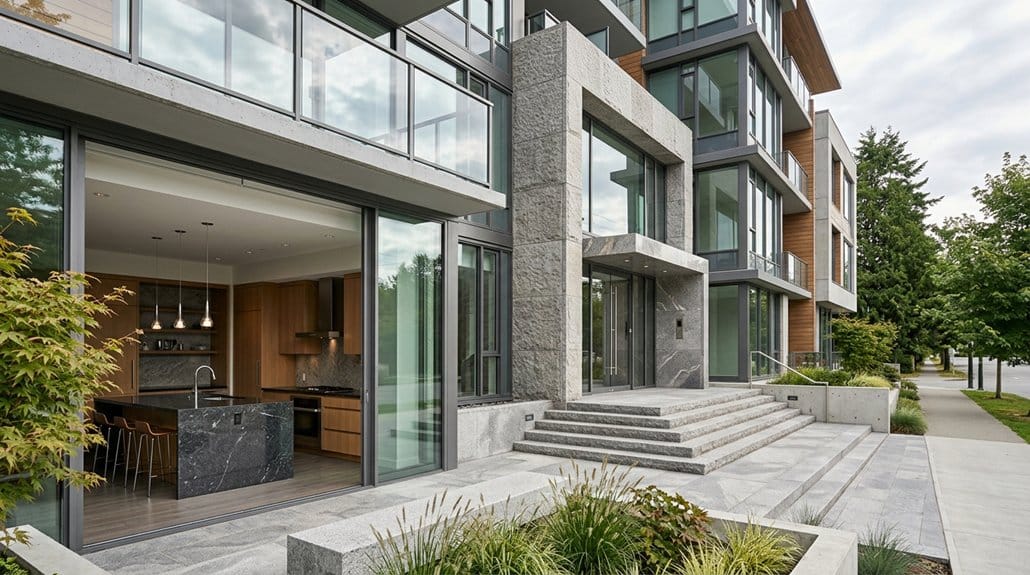
You can make granite work as hard as it looks good. In your home, it handles kitchen counters and bathroom vanities; in commercial buildings, it withstands heavy foot traffic and weather as flooring or exterior cladding. Its performance depends on more than stone selection: finish, substrate preparation, installation, sealing, and routine care all matter. Before choosing a slab, consider where it’ll be used—and which trade-offs could affect its service life.
Granite Kitchen Countertops and Islands
Granite countertops and islands provide durable, heat-resistant work surfaces that can anchor a kitchen’s design. You’ll find that granite’s crystalline structure resists everyday abrasion, while its natural variation gives each slab distinctive color and veining.
For effective kitchen design, select slabs in person and plan the layout around the pattern, seams, sink cutouts, and edge profile. A fabricator can template the cabinets, reinforce overhangs, and position seams where they’re less visible.
Material comparison helps you weigh granite against engineered surfaces: granite tolerates heat well, but it requires periodic sealing to limit staining. Use a penetrating sealer suited to the stone’s porosity, and clean spills promptly with a pH-neutral product.
Support heavy islands properly, especially at cantilevered seating, and verify cabinet levelness before installation. These steps protect performance and appearance.
Granite Bathroom Vanities and Walls
Granite gives your bathroom vanity a durable, moisture-resistant surface when you seal it and detail sink cutouts correctly.
For wall cladding, you’ll need a suitable substrate, compatible setting materials, and secure anchoring for heavy slabs.
Follow the stone supplier’s guidance for sealing and use pH-neutral cleaners to protect the finish.
Vanity Durability
How well does a bathroom vanity withstand daily moisture and use? Granite offers strong abrasion resistance and handles routine splashes, but durability depends on fabrication, installation, and maintenance. Choose a slab with sound structure; fissures near cutouts can weaken narrow sections. Your installer should reinforce sink openings, support overhangs, and seal joints against water intrusion.
- Seal the surface with a compatible penetrating sealer; renew it as product guidance requires.
- Wipe spills promptly, especially acidic toiletries that can etch calcite in some stones.
- Use a cutting board and avoid placing hot tools directly on the countertop.
- Clean with pH-neutral stone cleaner, not abrasive pads or acidic household products.
- Inspect caulk and seams regularly; repair gaps before moisture reaches cabinetry.
Granite interior accents and granite decorative panels can coordinate the vanity, but keep exposed edges properly finished and sealed.
Granite Wall Cladding
Beyond the vanity, granite wall cladding can extend a bathroom’s stone finish while protecting surfaces from routine splashes. You can specify full-height panels behind a basin or shower, or use a backsplash to define the vanity zone.
Natural stone varies in veining, color, and movement, so review slab samples under the bathroom’s lighting before selecting a layout. Your installer should confirm substrate flatness, waterproofing, and compatible setting materials; these details help prevent lippage and moisture intrusion.
Large-format slabs reduce grout lines, while smaller pieces accommodate niches and tight corners. Coordinate seams with plumbing fixtures and cabinet edges for a deliberate finish.
In Architectural design, granite’s visual weight pairs well with restrained fittings and clear glass, giving you a durable, cohesive surface without overwhelming the room.
Care and Maintenance
To keep bathroom granite in good condition, wipe vanity tops and wall cladding with a soft cloth and a pH-neutral stone cleaner, then dry them to limit water spots and mineral buildup.
Protect it:
- Follow consistent cleaning schedules: clean high-use vanities daily and walls weekly.
- Blot spills promptly, especially cosmetics, oils, and acidic toiletries.
- Avoid abrasive pads, bleach, vinegar, and other acidic cleaners that can etch or dull surfaces.
- Apply sealing techniques: test water absorption first, then use a penetrating impregnator as needed.
- Inspect grout joints, seams, and faucet penetrations; repair failed sealant to prevent moisture intrusion.
Don’t assume sealer makes granite stain-proof; it only slows absorption. Follow the product’s cure time before exposing surfaces to water, and maintain ventilation to reduce dampness and soap residue.
Count 124? Let’s count. To1 keep2 bathroom3 granite4 in5 good6 condition7 wipe8 vanity9 tops10 and11 wall12 cladding13 with14 a15 soft16 cloth17 and18 a19 pH-neutral20 stone21 cleaner22 then23 dry24 them25 to26 limit27 water28 spots29 and30 mineral31 buildup32.
Use33 these34 practices35 to36 protect37 the38 stone’s39 finish40:
- Follow41 cleaning42 schedules43 clean44 high-use45 vanities46 daily47 and48 walls49 weekly50.
- Blot51 spills52 promptly53 especially54 cosmetics55 oils56 and57 acidic58 toiletries59.
- Avoid60 abrasive61 pads62 bleach63 vinegar64 and65 other66 acidic67 cleaners68 that69 can70 etch71 or72 dull73 surfaces74.
- Apply75 sealing76 techniques77: test78 water79 absorption80 first81 then82 use83 a84 penetrating85 impregnator86 as87 needed88.
- Inspect89 grout90 joints91 seams92 and93 faucet94 penetrations95; repair96 failed97 sealant98 to99 prevent100 moisture101 intrusion102.
Don’t103 assume104 sealer105 makes106 granite107 stain-proof108; it only109 slows110 absorption111.
Follow112 the113 product’s114 cure115 time116 before117 exposing118 surfaces119 to120 water121 and122 maintain123 ventilation124 to125 reduce126 dampness127 and128 soap129 residue130.
Granite Flooring for Homes and Businesses
Granite flooring gives your home a durable, natural-stone surface.
In commercial settings, heavy-duty slabs withstand high foot traffic in businesses.
Choose a polished, honed, or flamed finish to balance slip resistance, appearance, and use.
Your maintenance plan should match the finish and include pH-neutral cleaners and periodic sealing where needed.
Residential Granite Flooring
Where does granite flooring perform best? In your home, granite suits entryways, kitchens, and living areas where you want a durable, polished surface with distinctive natural variation. As natural stone, each slab or tile differs in veining, so inspect samples under your room’s lighting before selecting a finish.
- Choose honed granite for lower glare and a softer appearance.
- Use polished surfaces where you want stronger color depth.
- Specify slip-resistant finishes for wet-prone areas.
- Confirm substrate flatness and load capacity before installation.
- Seal grout and stone according to product guidance.
Professional installation techniques help control lippage, align patterns, and accommodate movement joints. Your installer should use a compatible thin-set mortar and verify that the subfloor is stable and dry.
Plan transitions carefully at doorways, and coordinate tile dimensions with cabinetry and fixtures. Routine cleaning with a pH-neutral stone cleaner preserves the finish without damaging the sealer.
Commercial-Grade Durability
Beyond residential rooms, granite flooring handles the sustained foot traffic common in offices, hotels, and retail spaces. Its dense crystalline structure resists abrasion, indentation, and impact, making it a dependable choice for high-traffic zones.
You’ll get the best performance when you match slab thickness and stone grade to expected loads, substrate conditions, and installation methods. In commercial projects, a properly engineered base and full mortar coverage help distribute stress and reduce the risk of cracking under rolling carts or concentrated loads.
Granite’s natural variation also means you should review samples and specify acceptable color and veining ranges before ordering. Consider environmental impact and sourcing ethics when selecting a quarry and supplier; documented origins and responsible extraction practices support informed procurement.
With suitable design, granite can serve homes and businesses for decades.
Finishes and Maintenance
When you choose a finish, balance appearance with slip resistance and maintenance needs. Polished granite reflects light and highlights granite color variations, but can become slippery when wet. Honed or flamed surfaces offer more traction for entrances, kitchens, and commercial corridors. Match the finish to foot traffic and exposure.
- Seal porous stone after installation; confirm compatibility with the granite.
- Use pH-neutral cleaner and a microfiber mop for routine care.
- Wipe spills promptly, especially acidic liquids that can dull the surface.
- Place walk-off mats at entries to limit grit and abrasion.
- Inspect grout and sealant periodically; repair failures before moisture penetrates.
Choose locally sourced slabs when practical to support environmental sustainability and reduce transport impacts. Your maintenance schedule should reflect traffic, finish, and sealer performance; avoid abrasive pads and harsh chemicals that can damage the surface or compromise the protective treatment.
Granite on Building Exteriors
Granite gives building exteriors a durable, low-maintenance finish while adding natural variation in color and texture. You can specify it as cladding, rainscreen panels, base courses, or entrance surrounds, matching the application to structural loads and exposure.
Anchor panels with engineered kerfs, clips, or undercut systems, and allow movement at joints to accommodate thermal cycling. Coordinate panel dimensions, support framing, flashing, and drainage early; sound detailing limits water intrusion and staining.
Architectural integration depends on balancing slab thickness, finish, coursing, and joint layout with the building’s proportions.
Evaluate environmental impact by considering quarry distance, fabrication waste, transport, and service life. Granite’s durability can reduce replacement frequency, but you’ll still need compatible sealants, secure fixings, and periodic inspections.
Confirm wind-load performance, anchorage capacity, and code requirements before installation.
Granite in Commercial Spaces
In commercial spaces, granite combines a hard-wearing surface with a distinctive finish for reception desks, flooring, counters, and wall accents. You can use its mass and thermal properties to support performance goals while reinforcing a polished brand identity. Specify applications around traffic patterns, structural loads, and adjacent materials.
- Reception counters create durable, high-impact focal points.
- Floor slabs handle concentrated foot traffic in lobbies.
- Wall cladding adds visual depth to meeting areas.
- Granite surrounds protect service counters from daily wear.
- Coordinated surfaces establish continuity across public zones.
Granite’s density can influence interior acoustics: pair it with absorptive ceilings, panels, or flooring underlays to control reverberation. Its thermal mass may contribute to energy efficiency when integrated with a suitable building envelope and HVAC strategy.
Coordinate slab dimensions, anchorage, and joint locations with your architect and installer to meet project requirements.
Choose Granite by Finish, Durability, and Upkeep
Selecting granite for a specific application means balancing finish, wear resistance, and maintenance needs. A polished surface highlights granite color variations and resists staining when sealed, but it can show scratches and glare.
Honed granite offers a matte appearance with better traction, though its open pores may need more frequent sealing. Flamed or brushed finishes suit exterior paving and high-traffic areas because their texture improves slip resistance.
Match stone hardness and finish to expected loads, abrasion, moisture, and cleaning chemicals. For countertops, specify a suitable thickness, supported edges, and a compatible penetrating sealer.
For floors, assess slip ratings and plan routine neutral-pH cleaning; avoid acidic products that etch mineral components.
You should also weigh quarry sourcing, transport distance, and fabrication waste to reduce environmental impact. Follow the supplier’s maintenance schedule to preserve performance.
Frequently Asked Questions
Is Granite Environmentally Sustainable Compared With Other Building Materials?
Granite’s Environmental impact is mixed: you gain exceptional durability and low maintenance, but quarrying, processing, and transport consume energy. Compare lifecycle assessments, sourcing distance, and sustainability practices before choosing it over recycled or locally available materials.
How Is Granite Quarried, Transported, and Fabricated?
You’ll see Quarrying techniques use diamond-wire saws, drilling, and controlled splitting to extract blocks. Trucks or ships transport them to plants, where Fabrication processes cut, polish, and finish slabs to your specifications.
Can Granite Be Customized Into Unusual Shapes or Intricate Designs?
Yes, you can customize granite into Custom shapes and Intricate designs using CNC routers, waterjets, and hand finishing. Your fabricator can create precise curves, profiles, inlays, and cutouts, while accounting for stone thickness, veining, and structural support.
What Should I Know About Granite’s Weight and Structural Support Requirements?
Granite’s substantial weight demands sturdy support—think of a loaded bridge, not a lightweight shelf. Check structural load capacity, guarantee even weight distribution, and reinforce cabinets or floors before installation; consult an engineer for oversized slabs.
How Can I Verify Granite’s Origin and Ethical Sourcing?
Verify granite’s origin by requesting quarry documentation, chain-of-custody records, and independent granite certification. Check supplier audits against ethical sourcing standards, labor protections, and environmental requirements; confirm certificates with issuing bodies, and reject unverifiable claims before purchasing.
Leave a Reply