

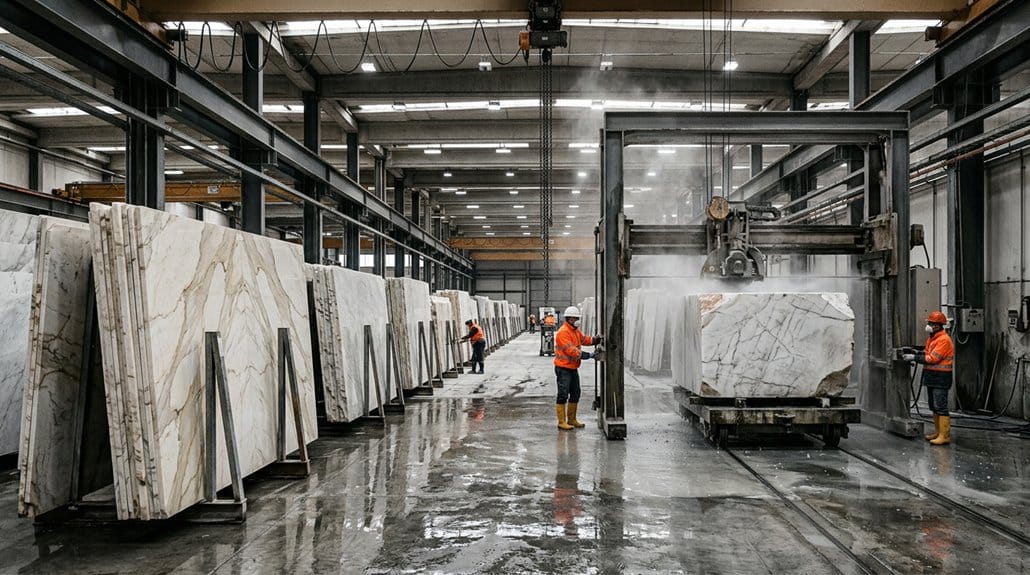
A raw stone block enters the plant as a rough mass; precision turns it into a finished product. You’ll see technicians inspect and prepare each block before automated saws, polishing lines, and CNC equipment shape it to specification. Sensors track thickness, alignment, and surface quality, while handling systems keep heavy material secure. But the process depends on more than machinery: one early inspection can determine every step that follows.
How a Stone Processing Plant Prepares Raw Blocks
Before cutting begins, a stone processing plant inspects each raw block for dimensions, cracks, and structural defects. You’ll see operators record measurements, identify the stone type, and assess whether the block meets production specifications. This evaluation helps you plan material use, reduce waste, and prevent unsuitable stone from entering the workflow.
Next, workers remove loose debris and prepare block surfaces for secure handling. Cranes, clamps, and automated robotics position heavy stone safely, while sensors can verify load stability and track movement. Your plant may also document each block’s origin, grade, and assigned production order for traceability.
Eco-friendly practices begin during preparation: water systems capture runoff, and careful grading helps limit discarded material. With accurate inspections, controlled handling, and clear records, you establish consistent quality and protect workers before the block advances to the next processing stage.
From Block to Slab: How Natural Stone Is Cut
Once a block clears inspection, it moves to a gang saw or multiwire saw, where tensioned blades cut through the stone along programmed paths. You’ll see the machine secure the block while feed systems regulate blade travel and cutting speed.
Abrasive slurry or diamond wire removes material, and water cools the cutting zone, limits dust, and carries away stone fines. Operators monitor alignment, blade wear, and feed pressure to prevent deviation, breakage, and uneven slab thickness.
The chosen settings depend on stone hardness, block dimensions, and the required yield. Compared with quarry extraction, controlled plant cutting can reduce offcuts through accurate planning, helping limit environmental impact.
After cutting, workers separate slabs, identify defects, and record dimensions for inventory. Each slab is then ready for the next production stage, without changing its cut face.
How Stone Slabs Are Polished and Surface-Finished
After cutting, slabs enter a finishing line where calibrated abrasive heads remove saw marks and progressively refine the surface. You’ll see operators sequence grit grades from coarse to fine, controlling pressure, feed speed, and water flow to limit heat and prevent scratches.
For polished finishes, successive polish techniques use finer abrasives or resin-bonded pads to develop clarity and depth. Automated sensors monitor thickness and surface response, while technicians inspect for pits, veins, and uneven sheen.
Surface gloss is measured against product specifications, then adjusted through additional passes or a different abrasive sequence. If you need a honed, brushed, or leathered texture, specialized heads create a controlled matte or tactile finish instead.
Slabs are rinsed and dried between stages so residue won’t compromise the final treatment, inspection, or protective application before packing.
How Slabs Are Cut and Shaped for Projects
Once you’ve selected a slab, CNC saws cut it to project dimensions, following digital templates and specified tolerances.
You can also specify custom edge profiles, which are shaped with dedicated tooling to match the design and installation requirements.
Precision Slab Cutting
Before fabrication begins, each stone slab is measured and programmed for its intended application. You’ll see automated measurement capture slab dimensions and map natural features, helping operators position cuts around veins, fissures, and defects. Laser calibration aligns the cutting head with the programmed coordinates, reducing deviation across the work surface.
Once the layout is approved, a bridge saw or CNC waterjet follows the digital path. You’ll select the cutting method according to stone hardness, thickness, project tolerances, and edge requirements. Controlled feed rates and blade depth limit chipping, heat buildup, and material stress. Water flow cools the blade and clears abrasive residue during cutting.
After separation, each piece is checked against its dimensions and project drawings. You’ll confirm fit, orientation, and surface integrity before parts move to subsequent fabrication stages.
Custom Edge Shaping
With the cut pieces verified, fabricators shape their edges to match the project’s profile and finish specifications. You’ll see CNC routers or profile machines mill details such as eased, bullnose, ogee, and bevel edges, using programmed tool paths for consistent geometry.
Operators select diamond tooling suited to the stone’s hardness and monitor feed rate, water flow, and tool wear to limit chipping and heat damage. For complex profiles or short runs, skilled craftspeople may refine corners and gradual changes by hand.
Historical techniques relied on manual chisels and abrasive stones; modern equipment improves repeatability while preserving options for custom work. You should confirm the specified radius, edge thickness, and polish level before fabrication.
Water recirculation and accurate machining also reduce waste, helping limit the environmental impact of rework and discarded stone.
How Plants Check Stone Quality at Every Stage
Quality checks begin at the quarry and continue through processing, fabrication, and final inspection. You’ll see inspectors assess each block for fractures, mineral inclusions, and weathering before it enters production. They record Stone hardness and color consistency, comparing samples with project specifications to identify unsuitable material early.
During cutting, operators monitor slab thickness, surface flatness, and dimensional tolerances with calibrated gauges. You’ll find visual checks paired with measurements, since blade wear or feed variation can affect finish and size.
After polishing, technicians inspect gloss, resin repairs, edge profiles, and visible defects under consistent lighting.
At fabrication, templates and digital measurements verify cutouts, seams, and finished dimensions. Final inspection confirms that each piece matches approved drawings and quality criteria. If a result falls outside tolerance, the plant flags it for correction before release.
How Finished Stone Is Packed and Shipped
You’ll see finished stone protected with edge guards, interleaving, and moisture-resistant wrapping suited to its surface and transport conditions.
Crews secure slabs or cut pieces to reinforced pallets, using restraints that limit movement without stressing the stone.
Shipping plans then coordinate handling, routing, and delivery to the job site or distributor.
Protective Packaging Methods
Before finished stone leaves the plant, crews protect it against impact, abrasion, moisture, and shifting during transit. You’ll see protective wrapping selected for the stone’s finish and dimensions. Nonabrasive foam, corrugated sheets, or felt separates polished faces from hard surfaces, preventing scuffs and edge contact. Crews fit corner guards to exposed edges, where chips commonly occur during handling.
For slabs, rigid face protectors distribute localized pressure, while cushioning materials provide shock absorption against vibration and minor impacts. Moisture-resistant films or covers limit exposure to rain and condensation, but packaging must suit the stone and shipment conditions.
For fabricated pieces, fitted inserts restrain movement without concentrating force on delicate profiles or cutouts. Labels identify orientation, handling limits, and fragile surfaces, helping you maintain protection through transfer and delivery. Packaging is inspected for coverage, secure closures, and damage before dispatch.
Secure Pallet Loading
Once protected, finished stone is loaded onto pallets or transport frames rated for its weight and dimensions. You’ll position each slab or piece to distribute weight evenly, keeping the center of gravity low and within the support footprint. Use separators and edge protection where needed to prevent contact damage.
Then, check that the frame’s contact points support the stone without stress concentrations. For pallet stability, you’ll align pieces vertically and avoid overhang that could shift under handling. Secure the load with rated straps, clamps, or restraints placed to hold the stone firmly without crushing corners or compromising packaging.
Add blocking where gaps allow movement, and tension restraints evenly. Before release, inspect the assembly for looseness, damaged supports, and visible imbalance. Confirm the load’s weight and dimensions match the pallet or frame rating, and document any handling requirements for the next stage.
Shipping And Delivery
With the pallet secured and inspected, finished stone is prepared for transport according to its size, weight, fragility, and destination. You’ll select a carrier and vehicle with adequate payload capacity, deck space, and restraint points. For slab shipments, use A-frames or purpose-built racks; crate smaller pieces with protective separators and moisture-resistant materials.
Secure every load against shifting, vibration, and impact, following applicable road and lifting regulations.
Shipping logistics also require accurate labels, packing lists, dimensions, weights, and delivery instructions. You’ll confirm site access, unloading equipment, appointment windows, and any import documentation before dispatch.
Delivery tracking lets you monitor transit milestones and identify delays early. Share the tracking details with your customer, then verify receipt, inspect for damage, and record proof of delivery.
Report discrepancies promptly so claims and replacements can be coordinated.
Frequently Asked Questions
What Types of Stone Are Commonly Processed in Modern Plants?
You’ll commonly encounter granite, marble, limestone, sandstone, slate, quartzite, and engineered stone in modern processing operations.
As the saying goes, “different stones for different needs”: each material calls for suitable cutting, shaping, and finishing. These types of stone vary in hardness, porosity, mineral composition, and intended application, so you’ll select processing techniques accordingly.
Plants typically produce slabs, tiles, countertops, cladding, and architectural components, using equipment configured for each stone’s physical properties and production requirements.
How Do Stone Processing Plants Manage Dust and Wastewater?
Stone processing plants manage dust and wastewater through engineered capture, filtration, and recycling systems.
For dust control, you’ll find water sprays at cutting points, local exhaust ventilation, enclosed conveyors, and baghouse filters that capture airborne particles. Operators monitor equipment and clean work areas to limit buildup.
For wastewater treatment, settling tanks separate stone fines from process water. Clarified water is recycled, while dewatered sludge is handled under applicable regulations.
You’ll also see routine testing and maintenance.
What Safety Measures Protect Workers Around Heavy Machinery?
You’re protected by machine guarding, interlocks, emergency stops, and lockout/tagout procedures that prevent unexpected startup during maintenance.
Machinery safety protocols require you to keep clear of moving parts, use designated walkways, and follow trained operating procedures.
Personal protective equipment includes safety glasses, hearing protection, cut-resistant gloves where appropriate, protective footwear, and hard hats.
You should never bypass guards, reach into operating equipment, or work near machinery without authorization and required training.
How Much Energy Does a Stone Processing Plant Consume?
A stone processing plant typically consumes hundreds to several thousand kilowatt-hours daily, depending on throughput, equipment, operating hours, and stone type. You’ll find power consumption concentrated in saws, polishing lines, compressors, pumps, and dust-collection systems.
A medium-sized facility may use roughly 50–200 kWh per tonne processed, though actual figures vary considerably.
For accurate benchmarking, you should monitor metered loads by production stage.
Energy efficiency improves through optimized cutting parameters, variable-speed drives, preventive maintenance, and reduced idle operation.
Can Plants Process Reclaimed or Recycled Stone?
Yes, you can process reclaimed or recycled stone in a plant, provided it’s inspected for contaminants, cracks, and dimensional suitability.
Recycling techniques include sorting, cutting, resurfacing, and crushing offcuts into aggregate for new products.
Equipment settings may need adjustment to accommodate variable hardness, thickness, and embedded materials.
Reuse can reduce demand for newly quarried stone and landfill disposal, lowering environmental impact.
Your quality-control checks should confirm structural performance and finish consistency before production.
Leave a Reply