

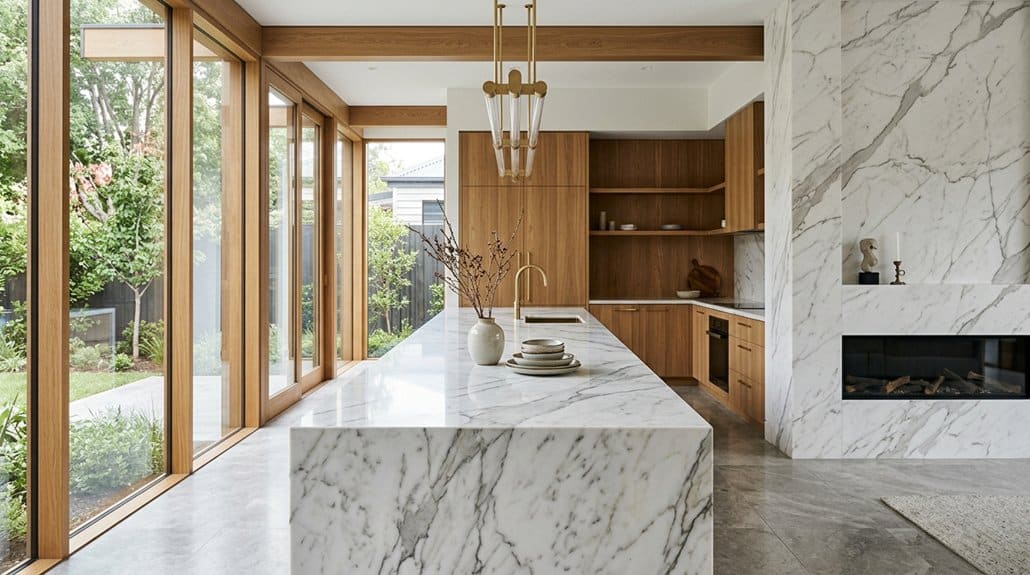
Marble can make a modern building feel both grounded and refined, but its performance depends on more than appearance. You’ll need to match each stone’s hardness, porosity, and veining to the demands of the space, then account for installation and maintenance. Choose well, and marble can deliver lasting elegance; overlook one practical detail, and that polished surface may become a costly liability.
Why Marble Works in Modern Construction
Marble works in modern construction because it combines structural durability with a distinctive natural finish. You can use it to bring visual character to floors, walls, stairs, and façades in residential and commercial projects.
Its marble color variations, veining, and surface patterns let you coordinate finishes with contemporary materials such as glass, steel, and timber. Marble’s historical significance also gives spaces a sense of continuity, while precise cutting and modern installation methods support clean, functional designs.
You’ll find it suitable for projects that need a refined appearance without relying on applied decoration. Specify marble where its natural look serves the design and the intended use justifies the material.
With thoughtful placement, you can connect modern construction to established architectural traditions and create interiors or exteriors that feel distinctive, composed, and enduring.
Which Marble Properties Matter Most?
When you select marble, assess its hardness and durability against the expected traffic and loads.
Check porosity, since it affects stain resistance and water absorption.
These properties determine the sealing and maintenance your installation will need.
Durability and Hardness
Although marble’s appearance often drives the initial choice, its durability and hardness determine how well it performs in service. When you assess Marble aesthetics alongside structural demands, compare the stone’s mineral composition, grain, and intended use. Hardness affects resistance to scratching; durability reflects how well marble withstands loads, impacts, and repeated use. Neither property alone guarantees suitability, so match the grade to the application.
- Flooring: Choose denser marble for busy areas where grit and foot traffic can abrade the surface.
- Countertops: Consider impact exposure and edge vulnerability before selecting a slab.
- Wall cladding: Verify strength and thickness against panel size and fixing requirements.
- Project selection: Weigh service life against replacement needs and Environmental impact.
Request technical data and samples, then confirm performance with your installer before specifying the stone.
Porosity and Maintenance
Beyond hardness and load resistance, porosity shapes how marble handles spills, staining, and routine cleaning. You’ll find that open pores absorb liquids faster, while denser stones resist penetration longer. Check the slab’s absorption rate and finish before specifying it for kitchens, bathrooms, or high-traffic floors.
Porosity management starts with a compatible penetrating sealer, applied according to the manufacturer’s instructions and renewed as needed. Sealing slows absorption; it doesn’t make marble stain-proof. Wipe acidic spills, such as citrus juice or vinegar, promptly, since acids can etch calcite even on sealed surfaces.
Use pH-neutral cleaners and soft cloths; avoid abrasive pads and acidic products.
Set cleaning frequency according to use, exposure, and finish. Inspect regularly for dull patches, water absorption, or stains, then reseal when testing indicates reduced protection.
Where to Use Marble in Modern Buildings
Modern buildings use marble where its durability, finish, and visual weight serve a clear purpose. You can use it to define high-traffic zones, add visual hierarchy, and connect contemporary interiors with historical significance. Marble aesthetics work best when the stone supports the building’s function rather than competing with it.
- Entrances and lobbies: Use marble flooring or wall panels to establish a durable, legible arrival sequence.
- Staircases: Apply it to treads, risers, or landings where solid construction and clear edges matter.
- Bathrooms: Use marble on floors, walls, and vanity surrounds to create cohesive, hard-surfaced rooms.
- Public interiors: Add it to reception desks, counters, or feature walls to mark key service points.
Coordinate marble with adjacent materials and structural details so progression remains safe, accessible, and visually controlled.
How to Choose Marble for Each Application
Choose marble by matching its hardness, porosity, finish, and slab characteristics to the demands of each application.
For floors and countertops, select dense, low-porosity stone with a honed or textured finish to improve traction and reduce visible wear.
On walls and fireplace surrounds, you can prioritize appearance, using polished slabs where moisture and abrasion are limited.
For showers, specify a suitable finish and confirm that the stone’s porosity works with the installation’s waterproofing and sealing system.
Review full slabs, not just samples: Marble pattern variations can shift markedly across a block, affecting veining alignment and visual continuity.
Compare Marble color options under the project’s actual lighting, and check how the chosen finish changes tone.
Before ordering, verify slab dimensions, thickness, defects, and vein direction; plan cuts and book-matched layouts to limit waste and achieve a coherent composition.
What Marble Costs to Maintain and Replace
Marble’s maintenance and replacement costs depend on its porosity, finish, location, and exposure to moisture or abrasion. You’ll spend less when you clean spills promptly, use pH-neutral products, and reseal porous stone as needed. Budget for periodic professional polishing if traffic dulls the surface.
- Routine care: Use soft cloths and stone-safe cleaners; avoid acids that etch marble.
- Sealing: Check absorption annually; resealing frequency varies by stone and use.
- Repairs: Expect added expense for chip filling, stain removal, or refinishing.
- Replacement: Compare slab, fabrication, removal, and disposal costs; matching Marble color variations may require sourcing extra material.
Historical marble uses show how durable stone can remain, but you’ll still need to assess damage before replacing it. Keep spare pieces when possible; discontinued colors can make repairs costly. Account for long-term upkeep when comparing marble with alternatives.
How to Install Marble for Lasting Performance
For lasting marble performance, prepare a clean, stable, level substrate before installation.
Choose an adhesive compatible with the stone, setting conditions, and substrate.
Seal the marble as specified, then maintain it with suitable cleaners and periodic resealing.
Prepare the Substrate
Before setting marble, make sure the substrate is clean, dry, level, and structurally sound. Your preparation techniques should address the surface material and installation conditions. Check substrate stability by inspecting for movement, cracks, weak areas, and excessive deflection; correct these issues before proceeding. A sound base helps prevent uneven support and tile damage.
- Remove dust, grease, paint, and loose material. Scrape or grind contaminants, then vacuum thoroughly.
- Check flatness with a straightedge. Fill depressions and remove high spots to meet the marble system’s tolerances.
- Repair cracks and damaged areas using suitable methods for the substrate. Don’t cover active movement joints; preserve them through the installation.
- Confirm the surface is fully dry and securely attached. For wood or other flexible bases, verify framing, fastening, and required reinforcement against project specifications.
Recheck the surface before installation; don’t proceed until it meets requirements.
Choose the Right Adhesive
Choose an adhesive formulated for both marble and the substrate to support a durable bond without staining or damaging the stone. Check the product’s technical data for approved stone types, substrate conditions, and interior or exterior use.
Adhesive compatibility matters because some products can cause discoloration, especially with light or translucent marble. For moisture-sensitive stone, select a non-water-based adhesive approved by the marble supplier. Confirm the adhesive also suits the tile’s size, thickness, and installation location.
Follow the manufacturer’s mixing ratios, working time, and curing requirements. Your application techniques should create continuous support: spread adhesive with the specified notched trowel, maintain consistent ridges, and avoid voids beneath each piece.
Back-butter large or uneven slabs when required. Set marble within the open time, press firmly, and check coverage by lifting a piece periodically. Remove excess adhesive promptly.
Seal and Maintain Marble
Once the adhesive has cured, apply a penetrating sealer approved for your marble and installation conditions. Marble sealing reduces absorption but won’t make stone stain-proof. Test the product on a spare piece, then follow its coverage, dwell-time, and ventilation instructions. Keep the surface dry until the sealer cures.
- Clean grout residue and dust with a pH-neutral stone cleaner; let the marble dry fully.
- Apply sealer evenly with a lint-free applicator, working in manageable sections.
- Remove excess within the specified time to prevent streaks or a hazy film.
- Reapply at the manufacturer’s recommended interval, or when water no longer beads.
For routine care, wipe spills promptly and avoid acidic cleaners, abrasive pads, and harsh chemicals.
Marble polishing can restore gloss, but use a stone professional for deep scratches or uneven wear. Follow care guidance to protect the finish and installation.
How to Clean and Protect Marble Over Time
Marble stays sound and attractive when you clean it with a pH-neutral stone cleaner, wipe spills promptly, and avoid acidic products such as vinegar or citrus, which can etch the surface.
For routine Marble cleaning, use a soft microfiber cloth and warm water; rinse away cleaner residue, then dry the stone to prevent water spots.
Don’t use abrasive pads, bleach, or ammonia, which can dull the finish or damage nearby grout.
Inspect high-use areas regularly for etching, stains, and worn protection.
Marble sealing reduces liquid absorption but won’t make the stone stain-proof.
Test the sealer in an inconspicuous spot, then apply a product formulated for marble according to its label.
Reapply when water no longer beads, or follow the manufacturer’s schedule.
Use coasters, mats, and cutting boards to limit exposure, and address damage with a stone-care professional.
Frequently Asked Questions
Is Marble Environmentally Sustainable Compared With Other Building Materials?
Marble isn’t automatically more sustainable than other materials. Its Environmental impact includes quarrying, transport, and processing, but Material longevity can offset replacement needs. You should compare local sourcing, lifecycle emissions, maintenance, and recyclability before choosing.
Can Marble Be Recycled or Reused After Demolition?
Yes, you can reuse marble after demolition by salvaging intact slabs, tiles, or blocks for new projects. You can also recycle fragments as aggregate. Marble restoration preserves surfaces, while Marble color options guide repurposing choices.
Does Marble Increase a Property’s Resale Value?
Yes, marble can increase your property’s resale value—if buyers appreciate its quality. What drives appeal? Marble color variability adds character, while Marble maintenance requirements may deter some buyers; choose durable finishes and maintain them carefully.
Where Is Marble Quarried Around the World?
You’ll find marble quarries in Italy, Greece, Turkey, Spain, India, China, Brazil, and the United States. Marble color variations reflect local geology; each region’s deposits carry Historical significance and distinct commercial characteristics for your project.
Can Marble Be Used With Underfloor Heating?
Yes—marble pairs with underfloor heating like a thermal bridge, conducting warmth efficiently. For reliable Underfloor heating compatibility, you’ll need proper Marble installation: use suitable adhesive, control heat gradually, and follow manufacturer temperature limits.
Leave a Reply