

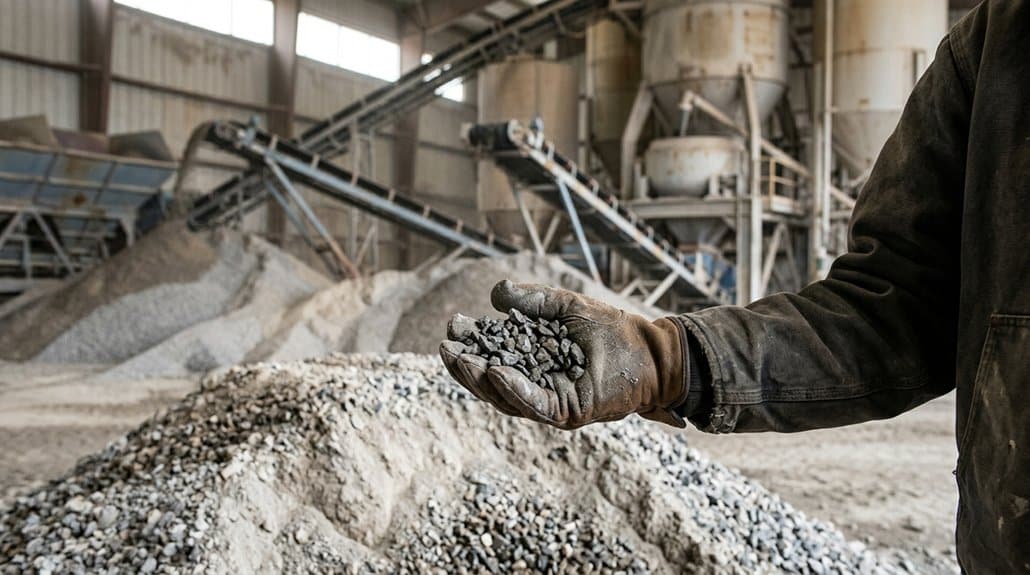
You might assume cement is the main factor in concrete performance, but aggregates make up most of the mix and strongly influence its behavior. When you select and proportion them, you affect workability, strength, durability, and cost. Size, shape, grading, and moisture all matter, so a seemingly minor change can alter how concrete places and performs. Understanding those effects starts with what aggregates do inside the mix.
What Do Concrete Aggregates Do in a Mix?
In a concrete mix, aggregates provide most of the volume and form the rigid skeleton that gives hardened concrete strength and dimensional stability. You rely on this framework to distribute loads, limit deformation, and reduce the amount of cement paste required.
Aggregate grading and proportioning affect workability, compaction, and the risk of segregation, so you need to balance particle sizes for consistent placement and a dense matrix. Clean, well-graded particles also help control shrinkage and improve durability by limiting excess paste and voids.
Moisture content matters: account for it when adjusting batch water to maintain the specified water-cement ratio.
Consider environmental impact when selecting and sourcing aggregate; efficient use can conserve resources and reduce transport emissions. Recycling methods can recover suitable material from demolished concrete, but you must verify its quality and adjust mix proportions as needed.
What Types of Concrete Aggregates Are Used?
Concrete aggregates are classified by particle size, source, and density, with each type suited to particular mix requirements. Fine aggregates, such as natural sand or manufactured sand, pass through a 4.75-millimeter sieve. Coarse aggregates, including gravel and crushed stone, remain above that threshold. You’ll select both categories according to the concrete specification.
By source, aggregates may be natural, manufactured, or recycled. Natural materials are quarried or dredged; manufactured options include blast-furnace slag and expanded clay. Recycled concrete aggregate comes from processed demolition debris and can replace some virgin material when it meets project standards.
Lightweight aggregates reduce concrete density, while heavyweight varieties, such as barite, support radiation shielding.
Consider environmental impacts when choosing extraction and processing methods. Recycling considerations include material quality, contamination, local supply, and applicable limits; these affect whether recycled aggregate suits your project.
How Do Aggregate Size, Shape, and Grading Affect Concrete Mixes?
Aggregate size affects how much water and paste you need to achieve workable concrete.
You’ll also find that rounded particles generally improve flow, while angular or elongated particles increase friction and may reduce workability.
Well-graded aggregates pack efficiently, helping you control voids, paste demand, and mix consistency.
Aggregate Size and Workability
When particle size, shape, and grading are well matched to the mix, aggregates can improve workability while reducing the water and paste needed. Larger coarse particles provide less total surface area to coat, so you may need less paste; however, they can hinder placement in thin sections or congested reinforcement.
Smaller particles increase surface area and paste demand, which can make a mix sticky if proportions aren’t adjusted. Select the maximum size to suit member dimensions, bar spacing, and placement equipment, then verify slump and finishability with trial batches.
Don’t add water to correct poor flow: that can lower strength and durability. Consider Aggregate durability when choosing a source, and weigh Environmental impact alongside performance.
Consistent sizing helps you maintain predictable batching, placement, and concrete quality.
Shape and Grading Effects
Beyond maximum size, particle shape and grading determine how efficiently aggregates pack and how much paste the mix needs. When you select materials, consider how particle geometry affects flow, compaction, and strength.
- Rounded particles improve workability and reduce water demand, but may provide less interlock than angular particles.
- Angular, elongated, or flaky pieces can increase friction, hinder placement, and create weak zones if they’re excessive.
- Well-graded aggregates fill voids across size ranges, reducing paste demand; gaps in grading can increase segregation and shrinkage risk.
- Surface texture influences paste bonding, while mineral composition affects durability, strength, and compatibility with cement.
Check grading with sieve analysis, then trial the blend at your target slump. Adjust proportions to balance pumpability, finishability, and aggregate interlock.
Don’t rely on shape alone: moisture, admixtures, and placement methods also change performance. Verify results through testing before production.
How Does Aggregate Quality Affect Concrete Performance?
Concrete performance depends on the quality of its aggregates, which make up most of the mix by volume. Clean, durable particles help you achieve reliable strength, dimensional stability, and resistance to wear.
Clay, silt, organic matter, or salts can weaken the bond with cement paste, increase water demand, or cause staining and deterioration. You should verify aggregate sources, grading, absorption, and soundness through testing before production.
Weak or porous particles may reduce strength and increase freeze-thaw damage, while reactive minerals can trigger damaging expansion. Consistent quality also helps you control workability and produce predictable results.
Consider Environmental impact when selecting materials: suitable Recycling methods can recover concrete aggregate and reduce demand for virgin resources. Check recycled material for contaminants and variability, then adjust quality controls to protect performance.
How Much Aggregate Does a Concrete Mix Need?
You’ll determine aggregate quantity from the mix design’s proportions of cement, water, and aggregate.
Calculate the required aggregate volume from the batch yield and convert it to mass using the aggregate’s bulk density.
Adjust the quantity for factors such as grading, moisture content, and the specified workability.
Mix Design Proportions
How much aggregate a concrete mix needs depends on the required strength, workability, exposure conditions, and placement method. You’ll select proportions through trial batches, balancing aggregate, cementitious materials, water, and admixtures to meet performance requirements. Don’t treat aggregate as a fixed percentage: grading, shape, moisture, and maximum size affect the mix’s behavior.
- Strength: You’ll control the water-to-cementitious-materials ratio and verify compressive strength with test specimens.
- Workability: You’ll adjust fine-to-coarse aggregate balance to support placement and finishing without segregation.
- Durability: You’ll account for exposure, absorption, and applicable limits on materials and water content.
- Sustainability: You’ll assess Environmental impact and suitable Recycling methods when choosing aggregate sources.
Use verified material data, correct batch weights for moisture, and document adjustments. Your approved proportions should remain consistent during production; retest when materials or conditions change. This keeps concrete workable, durable, and fit for its intended placement.
Aggregate Volume Calculations
To calculate aggregate volume, start with the approved mix proportions and the total concrete volume required. Convert each aggregate proportion into a consistent unit, then multiply it by the batch volume.
For example, if coarse aggregate represents 0.45 of the mix volume and you need 2 cubic metres of concrete, calculate 0.45 × 2 to obtain 0.9 cubic metres of coarse aggregate.
Repeat the calculation for fine aggregate, using the proportions specified in your mix design.
Check whether your proportions are based on mass or absolute volume; don’t treat them as interchangeable. For mass-based proportions, use the specified aggregate density to convert the required mass into volume.
Apply the same calculation to each batch size, and document quantities clearly. Accurate estimates support purchasing, reduce waste, and help you assess environmental impact and supply chain requirements.
Factors Affecting Quantity
The amount of aggregate a concrete mix needs depends on the required concrete volume, mix proportions, and aggregate grading. To estimate your order, account for these practical factors:
- Mix design: Follow the specified proportions; changing cement content or water-to-cement ratio can alter aggregate demand.
- Particle grading: Well-graded aggregates pack efficiently, while gaps between particle sizes may increase paste requirements.
- Moisture and absorption: Adjust batch quantities for aggregate moisture so you don’t unintentionally change the mix’s water content.
- Waste and placement: Include a measured allowance for spillage, uneven subgrades, and handling losses, rather than overordering.
Your project’s dimensions and placement method also affect the required volume. Confirm quantities against the approved mix design and site measurements before batching.
Consider Environmental impact when selecting local sources, and check supply chain reliability to prevent delays or substitutions that could change grading, quality, or proportions.
How Do Aggregate Choices Affect Strength, Durability, and Cost?
Aggregate selection affects concrete’s strength, durability, and cost because particle strength, shape, grading, and absorption influence both load transfer and the amount of paste required. If you choose strong, well-graded aggregate, you can improve load distribution and reduce voids, often lowering cement demand.
Angular particles may increase interlock but require more water or paste than rounded particles. Porous or absorptive aggregate can reduce workability and complicate water control, so you’ll need to adjust batch moisture.
For durability, match aggregate to exposure conditions. You should assess freeze-thaw resistance, abrasion, chemical stability, and potential alkali-silica reactivity. Unsuitable material can cause cracking, scaling, or premature deterioration.
Compare delivered price, processing, transport distance, and testing costs; local supply may reduce expense, but Environmental impact and sourcing challenges can limit availability. Verify quality consistently before specifying.
Frequently Asked Questions
How Should Aggregates Be Stored to Prevent Contamination?
Store aggregates on clean, hard, well-drained surfaces, separated by size and type, and protected from soil, runoff, and debris.
Effective storage methods include using designated bins or bays with retaining walls, covering stockpiles when needed, and keeping loading equipment clean.
Prevent trucks and loaders from crossing between materials.
Inspect stockpiles regularly, remove contaminated material, and manage drainage to avoid standing water.
These steps reduce Aggregate contamination and help maintain consistent concrete quality.
Should Aggregates Be Washed Before Mixing Concrete?
Wash aggregates before mixing only when they contain excessive clay, silt, salts, or other contaminants. Clean, specification-compliant material doesn’t need routine washing.
Poor aggregate cleanliness can weaken concrete and impair bonding, so check supplier data and project requirements.
If you wash aggregates, drain and allow them to reach a consistent condition before batching. Account for surface moisture by adjusting the mix water; otherwise, you may unintentionally change the water-cement ratio and concrete workability.
How Can Moisture in Aggregates Be Measured on Site?
You can measure aggregate moisture on site using a rapid moisture meter or a representative sample and a field drying test.
For the drying test, weigh the sample, dry it with a portable oven or microwave, then reweigh it; calculate Moisture content from the mass loss relative to the dry mass.
Calibrate meters against this method, sample several locations, and adjust batch water for measured moisture and absorption.
These measurement techniques help maintain consistent concrete proportions.
What Safety Precautions Apply When Handling Aggregates?
Treat aggregate handling like maneuvering a controlled hazard zone: you should plan each task before work begins.
Inspect handling equipment, including loaders, conveyors, and stockpiles, and keep guards, alarms, and access routes clear.
Wear suitable protective gear: safety boots, gloves, eye protection, and a dust mask or respirator when conditions require.
You should control airborne dust, avoid unstable pile faces, maintain safe distances from moving machinery, and use approved lifting procedures.
Don’t enter confined spaces without authorization.
Can Recycled Aggregates Be Used in Residential Concrete Projects?
Yes, you can use recycled aggregates in residential concrete projects when they meet local codes and the mix design’s performance requirements. Recycling processes remove contaminants and crush, screen, and grade reclaimed material.
Check aggregate quality for consistent grading, strength, absorption, and cleanliness; variable properties can affect water demand and durability. Ask your supplier for test data, and consult your engineer or contractor before specifying recycled content, especially for foundations, slabs, or other structural applications.
Leave a Reply