

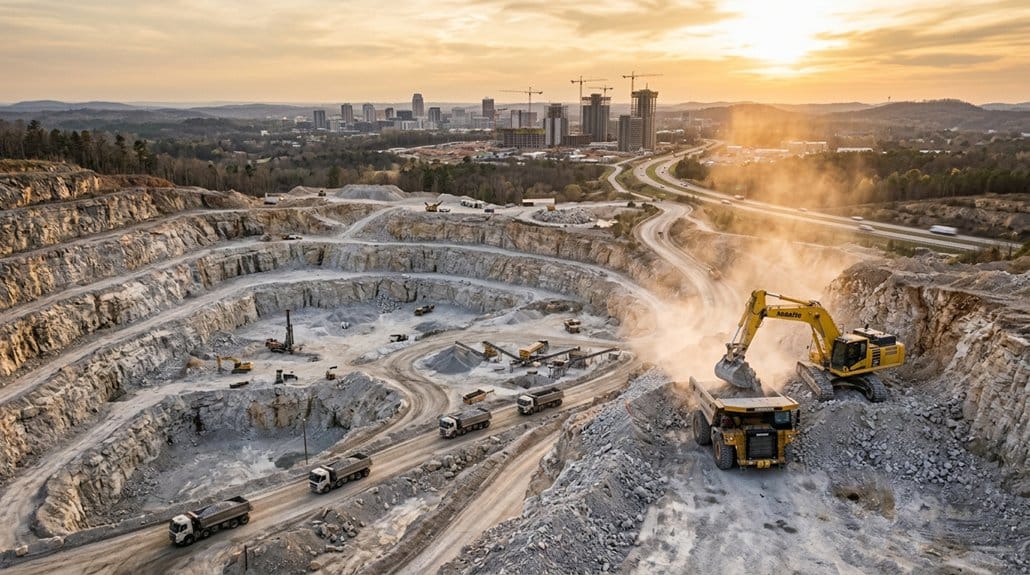
A quarry is the foundation beneath the structures you rely on every day. It supplies crushed stone, sand, gravel, and dimension stone for roads, homes, and infrastructure, where material quality affects strength, drainage, and service life. Modern extraction and testing help keep supply consistent, while careful sourcing can control transport costs and environmental impacts. But the value of quarrying depends on more than what leaves the site—it also depends on how those materials are selected and managed.
What Materials Does Quarrying Supply?
Quarrying supplies the bulk materials that form the foundation of most construction projects. You’ll find that quarries produce crushed stone, sand, and gravel, alongside dimension stone such as granite, limestone, and sandstone. These materials vary in size, strength, and durability, so you can select suitable grades for specific specifications.
Operations may also supply clay, slate, and other industrial minerals, depending on local geology and processing capacity. Mining techniques determine how rock is extracted, reduced, screened, and sorted into consistent products. Blasting, cutting, and mechanical excavation each suit different deposits and material requirements.
When evaluating suppliers, you should verify product grading, quality controls, and documented origin. Quarry safety procedures govern extraction and processing, protecting workers and nearby communities while supporting reliable production. Material testing confirms that delivered aggregates meet project requirements.
How Quarry Materials Support Roads and Homes?
Those graded aggregates become the working layers beneath roads and the structural components of homes. When you build a road, crushed stone forms a stable subbase that distributes traffic loads, supports drainage, and limits deformation. Proper grading and compaction help the pavement resist rutting, cracking, and water damage.
In home construction, sand and gravel contribute to concrete, while crushed stone supports foundations and improves drainage around structures. You’ll rely on consistent particle sizes and suitable strength to meet design specifications and site conditions.
These materials also support urban development by enabling dependable roads, housing, and essential services. Their correct selection and placement strengthen infrastructure durability, helping roads withstand repeated loading and homes remain stable over time.
Follow engineering requirements for aggregate quality, layer thickness, and compaction to achieve reliable performance.
How Quarry Sourcing Affects Project Costs?
When you source aggregates from a nearby quarry, you can often reduce transport costs, which may account for a substantial share of delivered material prices. Shorter haul distances also help you limit fuel surcharges and reduce exposure to delays that disrupt deliveries.
However, distance isn’t the only cost driver. Compare quarry prices, gradation, quality specifications, loading capacity, and delivery terms before selecting a supplier. Material that fails project requirements can increase costs through reprocessing, replacement, or schedule overruns.
Ask for current quotations and review how pricing may change with fuel rates, demand, and seasonal availability. This helps you anticipate cost fluctuation and prepare realistic budgets.
Strong sourcing reliability matters, too: a quarry with consistent stock and dependable dispatch helps you maintain production, avoid costly downtime, and meet project milestones.
How Quarrying Is Reducing Environmental Impacts?
As environmental standards tighten, modern quarries are reducing impacts through targeted controls for dust, noise, water use, and habitat disturbance. You can assess these measures through monitoring data and site plans.
Water sprays, enclosed conveyors, and wheel washing limit airborne particles, while acoustic barriers and scheduled blasting reduce noise near communities.
Settling ponds and closed-loop systems capture sediment and reuse process water, lowering withdrawals and protecting waterways.
Recycling initiatives turn suitable demolition material and quarry fines into usable aggregates, reducing landfill demand and pressure on virgin resources.
Progressive rehabilitation restores worked areas as extraction advances.
Through biodiversity conservation, operators can map sensitive habitats, protect buffer zones, and replant native species.
You should verify permits, rehabilitation targets, and reported performance to confirm that controls deliver measurable improvements throughout the quarry’s operating life.
Frequently Asked Questions
What Is the Difference Between a Quarry and a Mine?
A quarry is an open-air window into rock; a mine extracts valuable materials from the ground, either underground or at the surface.
You’ll typically find quarries producing stone, sand, and gravel, while mines yield metals, coal, or minerals.
Both require careful planning, but their Environmental impact differs with location, extraction methods, and rehabilitation.
You’ll assess Economic benefits alongside land use, safety, and restoration obligations before choosing or approving either operation for development projects.
How Is a Quarry Site Selected?
You select a quarry site by confirming that suitable, accessible rock exists in sufficient volume and quality. Geological surveys, test drilling, and laboratory analysis establish the deposit’s characteristics and extraction potential.
You’ll also assess transport links, water availability, land ownership, zoning, and proximity to communities.
Evaluate Environmental impact through baseline studies and permitting requirements.
Technological advancements, including remote sensing and 3D geological modeling, can improve site assessment, reduce uncertainty, and support safer, more efficient quarry planning.
What Permits Are Required to Open a Quarry?
You’ll typically need land-use approval, mining or extraction authorization, environmental permits, water and air approvals, and operating licenses; exact requirements vary by location.
For example, if you’re opening a limestone quarry beside a stream, you may need a water-use permit and erosion-control plan before excavation.
Check Environmental regulations early, including impact assessments and rehabilitation obligations.
You’ll also need Community engagement, often through public hearings, to address traffic, noise, dust, and concerns.
Consult local authorities and specialists.
What Safety Measures Protect Quarry Workers?
You safeguard quarry workers through layered controls: conduct site-specific risk assessments, secure highwalls, guard machinery, control vehicle routes, and manage blasting under strict procedures.
Provide Personal protective equipment, including hard hats, eye protection, hearing protection, high-visibility clothing, and respirators where needed.
Deliver regular safety training on hazards, equipment, emergency response, and reporting.
Inspect equipment and work areas routinely, maintain clear communication, enforce exclusion zones, and guarantee workers can stop unsafe operations immediately.
What Happens to a Quarry After Operations End?
After operations end, a quarry is typically decommissioned and reclaimed under an approved closure plan. You’ll see equipment removed, unstable slopes secured, and contaminated areas treated.
Environmental restoration may reshape land, replace topsoil, and establish native vegetation. Depending on site conditions and permits, the former pit might become a lake, park, or other productive use.
With careful monitoring, you can support a stable Wildlife habitat and reduce erosion, water-quality risks, and long-term maintenance needs.
Leave a Reply